
Noah knew the subject better than anyone in the room. He had built the analysis, checked the numbers, and answered every private question. Then he stood in front of forty people, felt his throat tighten, and rushed through fifteen minutes of material in seven.
Afterward, a less experienced colleague summarized the same recommendation in three clear sentences and won the decision. Noah did not lose because he lacked intelligence. He lost because his competence disappeared under pressure.
Public speaking is not an optional ornament for men who want money, status, leadership, and influence. Your ideas cannot command a room if your voice abandons them. You do not need to become a performer. You need to make your thinking visible when eyes turn toward you.
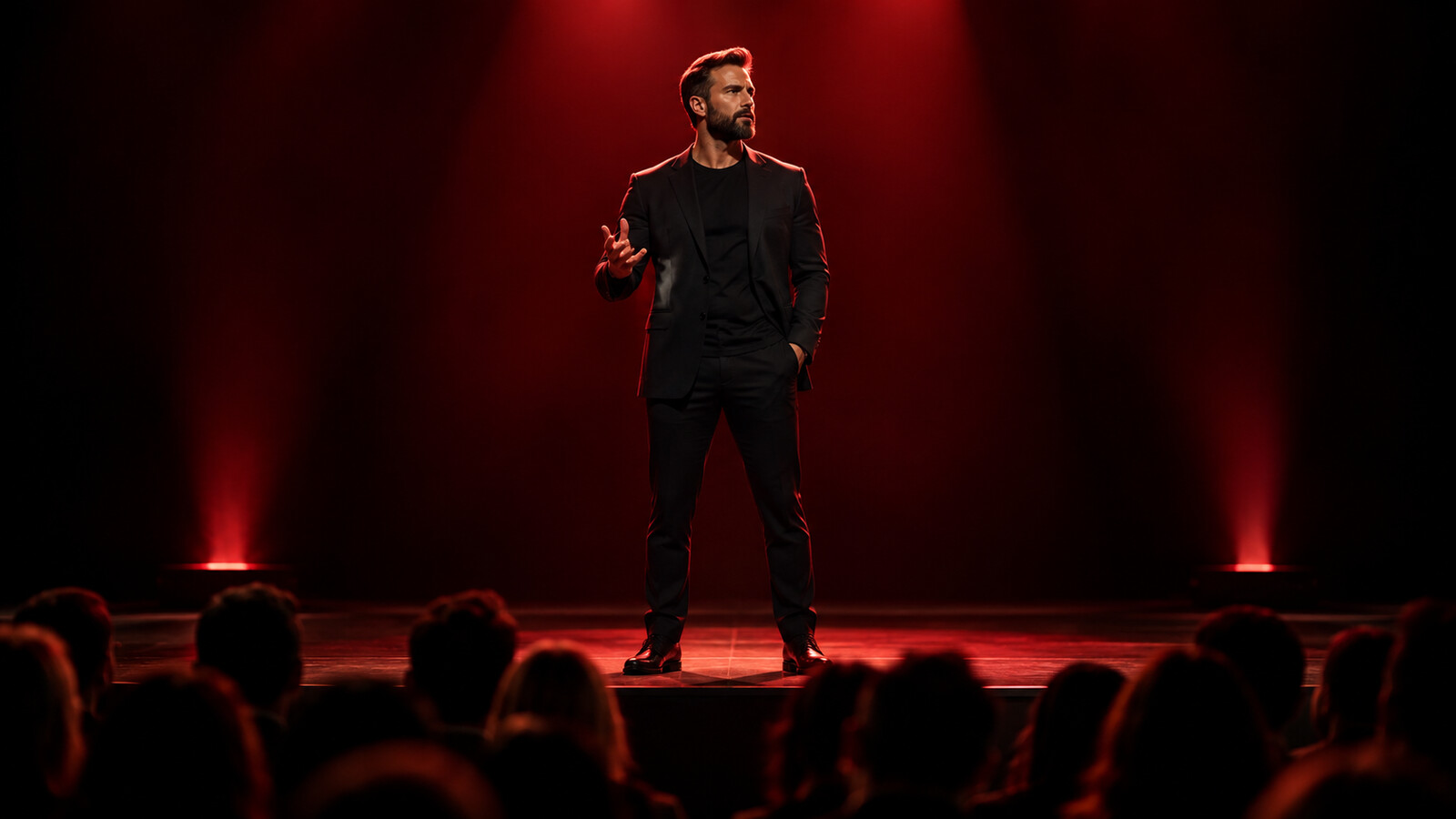
The Room Does Not Owe You Comfort
Men waste years waiting to feel confident before they speak. That sequence is backward. Confidence comes after repeated proof that you can enter pressure, feel the physical surge, and still execute the next sentence.
Your pulse may accelerate. Your hands may feel exposed. Your mind may predict humiliation. Fine. The objective is not to become a man with no nervous system. The objective is to stop obeying every alarm it produces.
Current research continues to examine exposure-based training for public-speaking anxiety, including simulated and virtual environments. The practical principle is simple: avoidance teaches your brain that the stage is dangerous. Controlled repetition teaches it that discomfort is survivable.
Know the One Decision You Want
Weak presentations begin with content accumulation. Strong presentations begin with an outcome. Before you open a slide or write a line, answer: What should the audience know, feel, or do when I finish?
If you want approval, state the decision. If you want action, name the next step. If you want belief, identify the central claim. One speech can contain supporting ideas, but it needs one spine. Without it, you will hide inside information because information feels safer than commitment.
Use a Structure That Survives Pressure
Do not trust adrenaline with a complicated map. Build the message around four moves:
- Problem: what matters and why the room should care now.
- Position: the claim or recommendation you are willing to defend.
- Proof: the strongest evidence, example, or reasoning.
- Command: the decision or action required next.
Memorize the first sentence, the central claim, and the final instruction. Do not memorize every breath. Word-for-word dependence makes one forgotten phrase feel like a collapse. Know the architecture well enough to rebuild the sentence while standing.
Train the Body to Carry Authority
Authority is not a costume. It is controlled physical behavior that supports the message. Plant your feet. Unlock your knees. Let your arms rest instead of clutching them to your torso. Inhale low before the first line. Speak to the back of the room.
Slow down more than feels natural. Fear makes men sprint because they want the exposure to end. That tells the audience you are trying to escape. Finish the sentence. Hold the silence. Let the point land.
Build the breath, resonance, and pace explained in how to develop a deeper voice. Do not force your pitch lower. Create a stable sound with breath support and deliberate pace.

Practice Under Escalating Pressure
Reading silently is not rehearsal. Thinking about speaking is not speaking. You need progressive exposure that makes the real environment familiar.
- Deliver the opening alone, standing, without notes.
- Record the full talk and watch it once without sound.
- Repeat it for one direct friend who will interrupt weak points.
- Rehearse in the actual room or a similar space.
- Invite hostile questions before the real event.
Each repetition needs a target. First structure. Then timing. Then delivery. Then questions. Trying to fix everything at once produces vague improvement. The deliberate practice approach in how to learn skills faster turns each rehearsal into a measurable correction.
Cut Language That Weakens Your Position
Stop opening with apologies. Stop saying, “I am not an expert, but…” when you have done the work. Stop wrapping a clear recommendation in five disclaimers because you fear disagreement.
Use direct sentences: “The current plan misses the deadline.” “I recommend option two.” “The evidence supports a different conclusion.” You can be accurate without hiding behind verbal fog.
If you explain long after the point is clear, apply the discipline required to stop overexplaining. Say enough to establish the claim. Then stop and let the audience respond.
Control the Question Period
A difficult question is not an ambush unless you panic and turn it into one. Listen to the entire question. Pause. Repeat the core if needed. Answer the strongest version instead of attacking a weak interpretation.
If you do not know, say, “I do not have that number. I will confirm it by tomorrow.” That sentence is stronger than improvising false certainty. If the premise is wrong, correct it: “That assumes the delay came from staffing. The timeline shows it began before the staffing change.”

Use Controlled Aggression, Not Stage Theater
A strong speaker brings force. He challenges a bad assumption, sharpens the contrast, and makes the cost of inaction visible. He does not apologize for conviction. That is controlled aggression in communication: deliberate intensity serving a goal.
Chaotic aggression shouts, humiliates, and treats every question as an enemy. It loses the room because it reveals insecurity. Your job is to increase pressure without losing judgment. Calm dominance makes the audience feel that you can carry the disagreement.
Combine that force with the social awareness in how to become more charismatic. Authority without connection can make people resist a good idea. Connection without authority makes them like you and ignore the decision.
Your Seven-Day Speaking Campaign
- Write a three-minute talk around one decision.
- Record it standing and remove every apology or filler phrase.
- Deliver it again at twenty percent slower pace.
- Give it to one person and request the hardest question.
- Repeat it in a larger room.
- Volunteer to speak once at work, in a group, or at an event.
- Score structure, pace, eye contact, and answer quality from one to five.
Your metric is not whether anxiety vanished. Your metric is whether you delivered the point while anxiety was present. That is usable confidence.
Conclusion: Make Your Competence Visible
You can remain the intelligent man nobody hears, or you can train until your voice carries the weight of your work. The room will not lower the pressure for you. Good. Pressure is where your preparation becomes status.
Choose one message this week. Build the structure. Rehearse out loud. Enter the room. Speak slowly enough to be understood and directly enough to be remembered. Your ideas deserve more than private confidence.
Frequently Asked Questions
How do I stop shaking during public speaking?
Use progressive exposure, deliberate breathing, slower pacing, and repeated rehearsal while standing. Do not make zero sensation the goal. Make controlled delivery the goal.
Should I memorize my speech?
Memorize the opening, central claim, transitions, and ending. Know the structure rather than depending on exact wording for every line.
What should I do if I forget my next point?
Pause, look at your outline, restate the central claim, and continue. The audience usually notices panic more than a brief pause.
How often should I practice?
Practice several short, focused repetitions across multiple days. Include at least one rehearsal under realistic pressure and one difficult question session.


Leave a Reply